
The Canadian government will require travellers from -affected regions to self-isolate for 21 days effective as of Wednesday.

In addition, immigration authorities are temporarily suspending applications from Democratic Republic of Congo, South Sudan and Uganda.
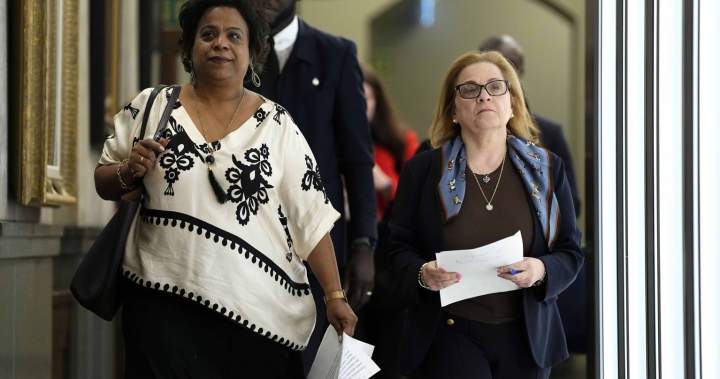
Health Minister Majorie Michel said in a press conference Tuesday afternoon that despite the self-isolation requirement, the health risk to Canadians “remains low.”
“We are putting forward a precautionary approach to ensure the safety and security of Canadians,” she said.
Immigration Minister Lena Diab also said that documents will not be cancelled.
“This is a suspension of documents, it is temporary. And while the measures are in place, once the measures end, documents that have not expired will be reactivated and there is no need for anyone to reapply,” she said.
She also expects these measures to be in place for 90 days.
Government officials stated before the press conference that on average, 350 people from the Democratic Republic of Congo, Uganda and South Sudan come to Canada each week.
The majority of passengers arrive in Toronto, Montreal and Vancouver airports, with about 60 per cent of flights being Canadians or permanent residents, whereas 40 per cent are foreign nationals.

With the FIFA World Cup set to kick off on June 11 and Canada hosting its first game in Toronto on June 12, concerns have mounted over precautions being taken across North America to prevent spread of the disease.
“With people coming in and out from those [affected] regions and we are [in] doing summertime and during FIFA [World Cup], I think the risk will be higher,” Michel said.
The U.S. Centers for Disease Control (CDC) and Prevention and the Department of Homeland Security on foreign travelers who have been in Congo, Uganda, or South Sudan in the past 21 days “effective immediately.”

Get weekly health news
Receive the latest medical news and health information delivered to you every Sunday.
Mexico also to the affected areas on May 17, which Michel said that Canada’s response is “in line with the U.S. and Mexico.”
Currently, there are no plans for a surrounding affected areas.
“Canada is a sovereign country. Canada will do what Canada feels it’s best to do,” said Diab. “We have put in measures that we feel are comfortable that will protect Canadians.”

The (WHO) of the rare Bundibugyo strain of Ebola a public health emergency of international concern on May 17.
WHO head Tedros Adhanom Ghebreyesus then that the fast-moving Ebola outbreak in Democratic Republic of Congo and Uganda was outpacing response efforts, giving the latest number of suspected deaths as 220.
He also said a delay in detecting Ebola cases meant responders were now “playing catch-up” and the epidemic was likely to get worse before it gets better, as containing the fast-moving outbreak was complicated by the fact that Congo’s Ituri and North Kivu provinces were highly insecure and there were no approved vaccines for Bundibugyo virus.
© 2026 Global News, a division of Corus Entertainment Inc.
