
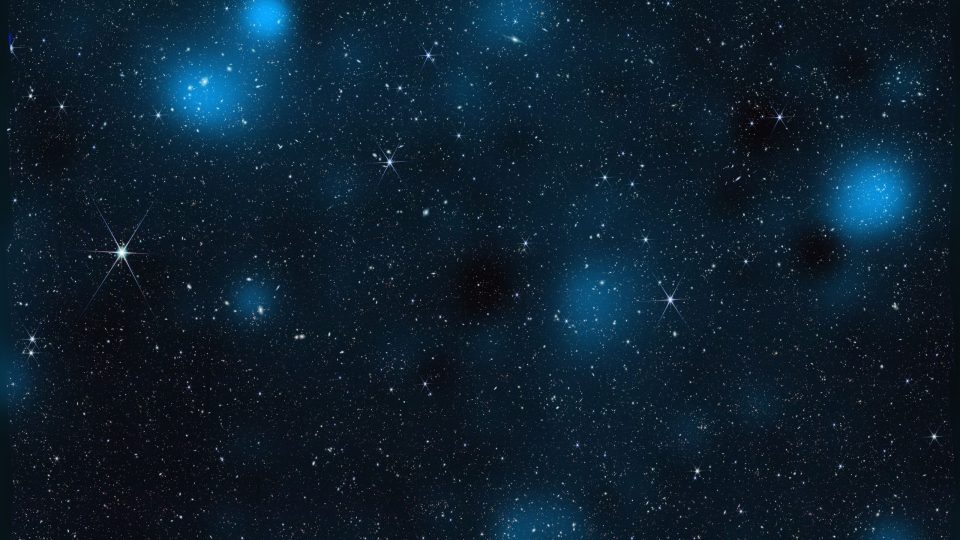
Using the James Webb Space Telescope (JWST), astronomers have mapped the largest section of the universe’s dark matter yet, deepening our understanding of how this mysterious substance shapes the cosmic landscape.
Dark matter is notoriously difficult to study because it does not interact with light. Astronomers can detect it only by looking at its gravitational effects on baryonic, or “ordinary,” matter. Observations of these interactions reveal that there is about five times as much dark matter in the universe as normal matter.
Next, the team charted how the mass of this area’s invisible dark matter warped the space around it.
“Previously, we were looking at a blurry picture of dark matter,” Diana Scognamiglio, an astrophysicist at NASA’s Jet Propulsion Laboratory (JPL) and co-lead author of the paper, said in a statement. “Now, we’re seeing the invisible scaffolding of the universe in stunning detail.”
Where galaxies come from

This detailed map could give scientists a better idea of how dark matter has shaped the evolution of the universe.
Shortly after the Big Bang, dark matter and ordinary matter were probably evenly distributed throughout space. But over time, dark matter began to clump together. This, in turn, pulled the ordinary matter into increasingly dense pockets, where it eventually collected enough mass to spark star formation.
In this way, dark matter was instrumental in creating the current layout and matter distribution of the cosmos. “This map provides stronger evidence that without dark matter, we might not have the elements in our galaxy that allowed life to appear,” study co-author Jason Rhodes, a senior research scientist at JPL, said in the statement.
Scognamiglio and her team plan to keep mapping dark matter in the future. They intend to use NASA’s Nancy Grace Roman Space Telescope, which is scheduled to launch later this year, to study an area 4,400 times the size of the region from the new study. However, Roman’s map of dark matter will be significantly less detailed than JWST’s.
Scognamiglio, D., Leroy, G., Harvey, D., Massey, R., Rhodes, J., Akins, H. B., Brinch, M., Berman, E., Casey, C. M., Drakos, N. E., Faisst, A. L., Franco, M., Fung, L. W. H., Gozaliasl, G., He, Q., Hatamnia, H., Huff, E., Hogg, N. B., Ilbert, O., . . . Weaver, J. R. (2026). An ultra-high-resolution map of (dark) matter. Nature Astronomy. https://doi.org/10.1038/s41550-025-02763-9
