
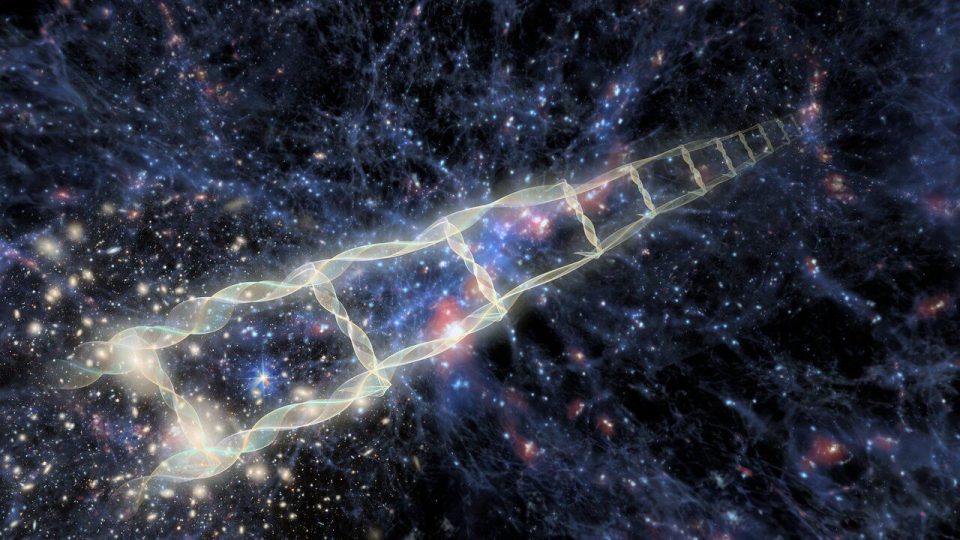
There’s a central crisis in cosmology: Different measurements yield different values for the expansion rate of the universe. Now, a comprehensive analysis combining decades of independent measurements suggests that this discrepancy is not due to error or uncertainty; instead, it’s a potential pathway to new physics beyond the standard cosmological model.
Astronomers calculate the universe’s expansion rate, or Hubble constant, in two ways. One method is to use measurements of the distance to the cosmic microwave background (CMB), the earliest light that spread out just 380,000 years after the Big Bang. The second method is to study the expansion of the local universe, using observations of “standard candles,” nearby stars of a known brightness whose light gets stretched — or redshifted — as it reaches us.
Although this seems like a diminutive discrepancy, it is far greater than statistical uncertainty can explain, presenting a puzzling disagreement known as the Hubble tension. So a large symposium of astronomers convened to vote on the best methods and data for constraining the Hubble constant and determining if the tension actually exists.
In the resulting paper, published April 10 in the journal Astronomy & Astrophysics, the authors derived the most precise Hubble constant yet and found that the tension persists, suggesting that our current cosmological model is incomplete.
“That’s why the Hubble tension is so interesting,” study co-author Richard Anderson, an astrophysicist at the University of Göttingen, told Live Science via email. “The comparison between the late and early-universe value of [the Hubble constant] tests basic physics on cosmological scales, and it tells us that something’s missing.”
The most comprehensive review of the expanding local universe
Previous cosmological calculations relied on the creation of a cosmic distance ladder. Its rungs comprise increasingly distant celestial objects, including pulsating Cepheid variable stars within the Milky Way and more distant supernovas, whose distances can be calculated from the difference in their intrinsic brightness versus how bright they appear to us after their light has traveled through expanding space.
Yet this recent community effort, launched at the International Space Science Institute Breakthrough Workshop in Bern, Switzerland, in March 2025, expanded the cosmic distance ladder into a comprehensive survey of the nearby universe called the Local Distance Network, achieving a lofty goal that was considered “potentially unreachable” a decade ago.

“This isn’t just a new value of the Hubble constant,” the researchers explained in a statement from the National Science Foundation’s NOIRLab; “it’s a community-built framework that brings decades of independent distance measurements together, transparently and accessibly.”
The unified framework combined decades of independent research using various techniques that may overlap in observations to achieve “redundancy” — an invaluable technique to reduce systematic errors and statistical anomalies.
For example, it allowed the researchers to perform a series of “leave me out” analyses: By excluding a specific technique, such as Cepheid-based calculations, they found a minimal change in the overall results of their newly constrained Hubble constant.
The foundations for a cosmic network
The Local Distance Network is founded on anchors — celestial objects whose distances have been determined geometrically through methods like parallax, an apparent change in an object’s position that occurs with a change in perspective. Space telescope access may be limited, but you can reproduce parallax yourself by holding a finger at arm’s length and seeing it seemingly shift positions by closing one eye and then the other.
Accordingly, the researchers used multiple local-universe anchor points, including the galaxy NGC 4258, located more than 20 million light-years away; the Magellanic Clouds, which are a pair of dwarf galaxies about 200,000 light-years away; and numerous variable stars within the Milky Way.
Then, they included a multitude of objects of measured distances, including dying old red giant stars and “megamasers,” the intensely bright cosmic lasers generated in the accretion disks of supermassive black holes.
The researchers also included more than 7,500 galaxies, observed by facilities such as the Hubble Space Telescope and the Dark Energy Spectroscopic Instrument, out to a distance of more than 1 billion light-years.
As a result, the Local Distance Network developed in this study represents the most precise direct measurement of the Hubble constant in the local universe: 73.50 kilometers per second per megaparsec, with a relative uncertainty of 1.09%. The conclusion? The Hubble tension is real, similar to previously measured values, and not just an artifact.
The fact that this discrepancy persists may hint that early-universe measurements need to be similarly reassessed on a deeper level.
“One interesting, relatively new, and perhaps more natural idea involves primordial magnetic fields, which could change the scale of the structure seen in the CMB,” study co-author John Blakeslee, director of research and science services at NOIRLab, explained via email.
Excitingly, this research further supports the idea that new physics are needed to illuminate dark energy and the other forces driving the expansion and ultimate fate of the universe. And because this framework is modular, upcoming methods and data from next-generation observatories may finally resolve the Hubble tension — but then again, that’s what cosmologists have been hoping for more than a decade.
Casertano, S., Anand, G., Anderson, R. I., Beaton, R., Bhardwaj, A., Blakeslee, J. P., Boubel, P., Breuval, L., Brout, D., Cantiello, M., Reyes, M. C., Csörnyei, G., De Jaeger, T., Dhawan, S., Di Valentino, E., Galbany, L., Gil-Marín, H., Graczyk, D., Huang, C., . . . Nota, A. (2026). The Local Distance Network: A community consensus report on the measurement of the Hubble constant at ∼1% precision. Astronomy and Astrophysics, 708, A166. https://doi.org/10.1051/0004-6361/202557993
