
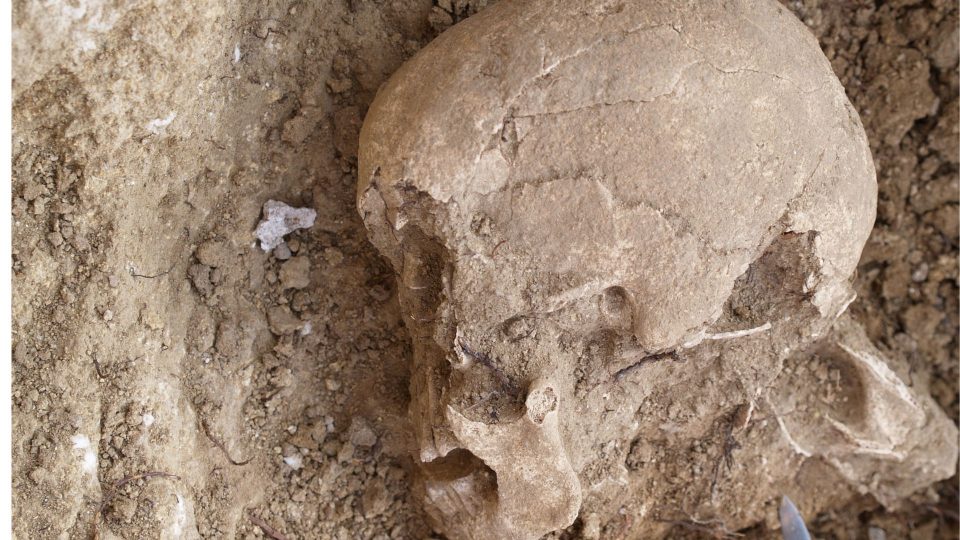
In medieval Spain, two men were buried in a prehistoric stone monument that had been constructed millennia earlier. Now, a new analysis of these burials is revealing clues about their ancestry but also leaving some mysteries, such as which religion they practiced.
For example, one of the men was related not only to European populations but also to people living in the Middle East and North Africa, including two people who are still alive today, according to the new genetic analysis.
Article continues below

In 2005, archaeologists unexpectedly found two additional burials within its atrium: one dating to around the eighth century or ninth century A.D. and another from around the 10th or 11th century, researchers wrote in a paper published in the February issue of the Journal of Archaeological Science: Reports.
Analysis of the remains found that the 10th- or 11th-century burial is of a man who was over 45 years old when he died. DNA tests showed that he had a mix of European, North African and Middle Eastern ancestry, the team found. The man’s Y-chromosome lineage matches one that “has been present in Spain since at least the Chalcolithic,” or Copper Age (3200 to 2200 B.C.) in Iberia, the researchers wrote in the new study.
When looking at this individual’s maternal lineage through his mitochondrial DNA, the researchers found that it matched one from Europe that has been known in Iberia since the Early Neolithic but is also found in modern-day northwest Africa. In fact, the medieval man shares a specific mutation with two modern-day African individuals in a genetic database — one in Morocco and another in Algeria.
It’s not surprising to find North African genes in a medieval man buried in Spain, the researchers wrote, noting that North African ancestry was “widespread” in southern Iberia from at least the third to fourth century, “probably connected with regular movement of people across the Mediterranean potentiated by Greek, Phoenician, and Carthaginian trade and, later, the Roman Empire,” they wrote in the study.

From the eighth to the 11th century, when these medieval men were buried at the Dolmen de Menga, southern Spain was part of Al-Andalus, a Muslim kingdom in Iberia. A variety of religions — including Islam, Christianity, Judaism and paganism — were practiced within this kingdom, the team wrote in the paper.
“With the onset of the Islamic period in 711 CE, contacts with North Africa were probably more frequent, enabled by political events and shared cultural practices,” the researchers wrote in the study.
The eighth- or ninth-century burial also appears to be of a man who was more than 45 years old, but his DNA was too fragmented for analysis; the researchers wrote that there was even an “intrusion of roots into some of the bones.”
Religion unknown
Both individuals were buried in simple pits with no grave goods. “Their heads were lying on their right side, pointing to the southwest — in line with the monument’s axis of symmetry — with their faces looking southeast,” in the direction of Mecca, the team wrote in the study.

The “apparent symbolic alignment of the inhumations with the axis of symmetry of the Menga megalithic monument contrasts with Islamic necropolises in the area,” the researchers wrote. The direction of the heads aligning with the dolmen itself is different from the other burials, study co-author Leonardo García Sanjuán, a professor in the Department of Prehistory and Archaeology at the University of Seville, told Live Science in an email
This leaves the question of which religion these two people practiced.
The “fact that both individuals were buried at the entrance of a monument which already at their time was extremely old, and with their heads pointing towards the interior of it, may be significant, indicating that these two men revered the dolmen,” García Sanjuán said. “Altogether, this suggests that their world view may have been a mixture of Islamic and pagan [beliefs].”
Leonor Rocha, an archaeology professor at the University of Évora in Portugal who was not involved in the study, told Live Science that it “seems very interesting to me, especially because they have preserved bones and because of the DNA analysis.” Rocha noted that the Alentejo region of southern Portugal also has evidence that people reused prehistoric megalithic monuments for burials during the Middle Ages, but no bones have been found there.
“In the Alentejo region, we have some evidence of reuse from that period, but unfortunately without preserved bones,” Rocha said in an email.
It’s possible that medieval people interpreted the dolmen as a cave, Yves Gleize, an archaeologist and biological anthropologist at the National Institute for Preventive Archaeological Research and the University of Bordeaux, told Live Science.
In the Muslim “world, the cave is an important place; for example, the prophet received the first revelations in the cave of Hira [near Mecca],” Gleize, who was not involved in the study, said in an email. He noted that caves were sometimes used as places of spiritual retreat.
Gleize added that he is interested in hearing more about the orientation of the burials and thinks it is best to be cautious about assigning them a specific religion.
Silva, M., Sanjuán, L. G., Fichera, A., Oteo-García, G., Foody, M. B., Rodríguez, L. E. F., Pendón, V. N., Bennison, A. K., Pala, M., Soares, P., Reich, D., Edwards, C. J., & Richards, M. B. (2025). Genetic and historical perspectives on the early medieval inhumations from the Menga dolmen, Antequera (Spain). Journal of Archaeological Science Reports, 69, 105559. https://doi.org/10.1016/j.jasrep.2025.105559
