
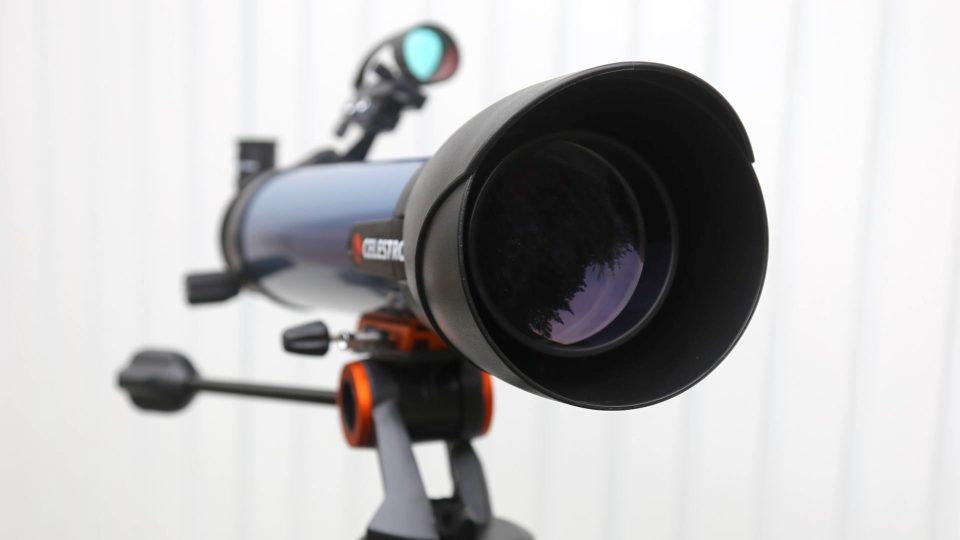
More magnification means better views, right? That’s the received wisdom among buyers of beginner’s telescopes, and it’s easy to see why. Telescope packaging often shouts about “300x power” as if bigger numbers automatically guarantee sharper, more dramatic sights. It’s an appealing idea: more zoom equals more detail. The reality, though, is way more nuanced.
Many beginners assume that cranking up the magnification will unlock breathtaking close-ups of planets and craters, but in practice, the opposite is often true — even in the very best telescopes. Chasing high magnification too soon can lead to dim, blurry, shaky views. Understanding what really determines image quality — and why prioritizing quality eyepieces typically produces better results — is the difference between frustration and a genuinely awe-inspiring first look at the night sky.
Article continues below
Telescope magnification explained

If anyone tries to tell you that one telescope is more powerful than another, walk away. A telescope is powerful for three reasons, the most important of which are aperture (how much light it lets in) and resolution (limited by aperture and by atmospheric turbulence). The least important is magnification — how much larger an object appears through your telescope compared to the naked eye — and yet this is the number almost everyone prioritizes.
Magnification is the focal length of a telescope (the distance from the primary lens or mirror to where light is focused — the focal plane) divided by the focal length of an eyepiece (the distance from the lens to the focal plane), so it’s not a fixed number; it changes depending on which eyepiece you use.
For example, a refractor telescope with a 4-inch aperture and a 900 mm focal length, used with 20 mm and 10 mm eyepieces (standard issue with telescopes), yields 45x and 90x magnification, respectively. You use the wider field-of-view eyepiece (20 mm) to find the objects, then switch to the 10 mm eyepiece to take a closer look — and hope the air is still (known as “good seeing” to amateur astronomers).
Why bigger isn’t always better

It’s tempting to chase higher magnification, but doing so comes at a cost. Switching from, say, 20 mm to 10 mm results in a dimmer image because the same amount of light is now spread over a larger area. Any atmospheric turbulence also becomes much more noticeable, often making the view blurry or unstable.
Magnification is limited by the physical design of a telescope, which can only magnify what its optics and aperture can resolve. According to Sky & Telescope, “a telescope’s maximum useful magnification is twice its aperture in millimeters, or 50 times its aperture in inches”. So for a 4-inch/102 mm telescope, around 200x is as far as you’re going to get — and that’s with good seeing. If you try to go beyond this limit, you’re not seeing more detail; you’re just enlarging a fuzzy image.
Understanding aperture

While magnification affects how large things appear, a telescope’s aperture will determine how well an object can be seen. The diameter of a telescope’s main lens or mirror — the aperture — establishes how much light your telescope can collect.
A larger aperture gathers more light, resulting in brighter images, greater detail, and the ability to detect fainter objects such as galaxies, nebulae and distant star clusters. This is why experienced stargazers often recommend focusing on aperture, not magnification, when choosing a telescope — and it’s also why physically larger telescopes will generally allow bigger, brighter views of faint objects.
Magnification may let you zoom in on something, but it’s the aperture that decides whether that zoomed-in view is sharp, detailed and, essentially, worth looking at.
Understanding eyepieces

Eyepieces are essential gear for a telescope owner. They attach to a telescope’s focuser and determine its magnification. Switching between eyepieces is how you zoom in or out — but which one is best?
Once you have a telescope and know its focal length, you can calculate the range of eyepieces worth considering. When you buy an entry-level telescope, you’ll typically get two eyepieces: one with a focal length of 20 or 25 mm, and one with a focal length of 10 mm. Sometimes you’ll also get a Barlow lens, an accessory that usually doubles the power of any eyepiece. Mostly, anything in the box is very basic and should be upgraded in the medium term. However, many telescopes come with no eyepieces included.
The higher the focal length, the wider, lower-magnification and brighter view you’ll get. Longer focal-length eyepieces are ideal for finding and centering objects in a telescope’s field of view. Then you can switch to a shorter focal-length eyepiece, which will produce a narrower, higher-magnification and usually dimmer view.
Choosing the right eyepiece

The best eyepiece does not exist. Which is best for you depends entirely on what you want to observe.
If you’re interested in the moon and planets, shorter focal lengths (typically 5–10 mm) will give you the close-up views you want. For galaxies, star clusters, and nebulae, longer focal-length eyepieces — such as 20 mm or even 30 mm — provide a wider, brighter view that’s ideal for deep-sky observing. That’s because objects differ in brightness and apparent size. For example, a 6 mm eyepiece may give you a close-up of a double star, but it will show only the center of the Andromeda Galaxy, which requires a low-power eyepiece, such as 20 mm.
As a general rule, it’s smart to start with two or three eyepieces that give you low, medium and high magnification options — and it’s likely the mid-range eyepiece, around 20 mm, that you’ll use the most.
Barlow lenses explained

A Barlow lens is an easy way to upgrade the performance of any eyepiece by effectively changing the telescope’s focal length. An accessory that goes between a telescope’s focuser and eyepiece, it increases the magnification of any eyepiece you use with it, usually by 2x or 3x. This means that a 10 mm eyepiece with a 2x Barlow will behave like a 5 mm eyepiece, allowing you to reach higher magnifications without buying more eyepieces.
However, while Barlow lenses can be a great value, you always get what you pay for. A good quality Barlow can effectively double your eyepiece collection, but a poor quality product will merely amplify the negatives associated with high magnification — such as a narrower field of view, dimmer images and a tendency to make poor atmospheric conditions seem even worse.
Dos and don’ts when buying eyepieces

Here are some dos and don’ts when buying eyepieces for your new telescope:
• One great eyepiece is better than 10 poor ones, so avoid large sets of eyepieces — they’re overkill and likely to be of only average optical quality.
• Don’t go straight to high-magnification eyepieces. If the view is blurry or dim, it may well be the “seeing” — astro-speak for a turbulent upper atmosphere — rather than the eyepiece. Besides, there’s only so much magnification a telescope can handle.
• Whichever eyepiece you are using, large reflector telescopes (such as a Dobsonian) should be left outside for about an hour before you use them. This will allow them to cool down, which will mean sharper views.
• Choose an eyepiece that’s comfortable to use and has plenty of eye relief (the distance your eye can be from the lens), particularly if you wear glasses.
• A good way to try out eyepieces is to attend a star party organized by your local astronomy club or society.
