
Nature is full of relationships: predator and prey, parasite and host, competitor versus competitor. But there is another, often-forgotten relationship that involves species working together for each other’s mutual benefit.
These relationships, called mutualisms, can be found across the natural world. For example, leaf-cutter ants collaborate with colonies of fungi they actively cultivate. Because leaf-cutter ants can’t digest plants themselves, they grow fungi in their nests and feed them leaf clippings. The fungi benefit from being actively fed, and the ants eat some fungi to access the plant nutrients. Neither species would survive without the other.
Article continues below
“The Call of the Honeyguide” has been nominated for the PEN/E.O. Wilson Literary Science Writing Award, an annual award for excellence in nonfiction in the physical or biological sciences. The award comes with a $10,000 cash prize, and the results will be announced March 31 at the Literary Awards Ceremony.
Live Science spoke with Dunn about his book and how mutualism is at the very root of what it means to be human.
Sophie Berdugo: Could you explain what mutualisms are and how you got interested in them?
Rob Dunn: Mutualisms — as ecologists and evolutionary biologists think about them — are relationships between two species when both benefit. So it’s cooperation among species. Ecologists and evolutionary biologists would measure that cooperation in terms of what we call fitness: Are the individuals more likely to survive and have offspring if they’re partnering with each other?
But if we think about modern human mutualisms, it becomes a little trickier to think about how we should measure them. And this is a question I think about throughout the book. What does it mean to have a mutually beneficial relationship with a dog or a cat or a cow or a pig or wheat? But fundamentally, at its base, it’s two species that together benefit more than they would going it on their own.
I got interested in them very early in my career. I spent a lot of time in the tropics, where lots of mutualisms are very conspicuous, and just became fascinated with all the different ways that species in the wild are partnering in a landscape in which we often think more about predation and parasitism and competition. This sort of kinder, gentler part of nature — that is nonetheless complicated — has long fascinated me.
SB: What made you decide to write this book now?
RD: In the last few years, I’ve been working more and more on human mutualisms and all kinds of strange mutualisms: humans and the microbes that live in our belly buttons, humans and the microbes in sourdough bread, humans and cats.
The more and more virtual we’ve become, the less and less aware we are of these interdependencies that we have all over the place. They don’t go away, but we don’t tend to them. We seem to be in terms of history today at maximum virtualness, maximum focus on our screens and on indoors, and there’s just not much precedent for paying so little attention to these other species that we’re engaged with. It felt like a time to tell this story.

I have also spent more and more time with archaeologists and anthropologists who have really made it clear to me how much more diverse these relationships have been through time and across cultures than we appreciate.
SB: I mean, even now we’re having a virtual interaction! I’m really intrigued by what you were saying there about your work with archaeologists and anthropologists. Could you share some of the insights you’ve learned through those collaborations, and how these mutualisms really teach us about who we are as a species?
RD: One kind of vignette would be thinking about our closest living relatives, chimps and bonobos, and the mutualisms they engage in. One of the things that’s very clear with chimps is they depend on every one of their actions on the plants that they eat. They depend on the figs for food, and the figs depend on them to disperse their seeds and carry them from one place to another.
That’s a very ancestral relationship for us. We all once lived in trees; we all once benefited from those trees; we all once benefited from those fruits. And so that’s one kind of thing we see in looking to a more ancient past. We still benefit from trees, but the nature of the relationship has changed. I think, often, when we look at other cultural or ancient contexts, there are lessons there, but the lessons are modulated by the way we live now.
Every time you take one of these examples and pick it apart, it gets more complex. The figs depend on the chimps, but the figs also depend on very specific wasps that pollinate them. Each fig species has a different fig-specific wasp. So embedded in the chimp-fig mutualism is this other mutualism, which is so often the case.
To take a very different kind of example, a number of researchers have started to focus on what you might call co-predation, where humans and other species team up to predate a third species. It’s now clear that, in several different human cultures and populations, people have formed partnerships with dolphins — the dolphins help herd fish into a bay, and then humans net the fish. And by netting them, the dolphins get a few more.
This is a relationship people in parts of Brazil still have and it probably emerged culturally many times.
The dolphins seem to be in charge. It’s the dolphins that tell the humans when to gather. It’s one cultural group of dolphins partnering with one cultural group of humans. It’s really an elaborate relationship that depends on particular people, particular dolphins. It’s embedded in culture.
Then there’s the trickiness of nature; this relationship really sucks if you’re the fish.
None of this is ever simple. One way to think about it is if you’re in a mutualism, you’re better than if you’re not. They always involve trade-offs, but nonetheless, [they] are this element in nature that has a different way of working than what we tend to think about.
SB: I’m really intrigued about who may be initiating these mutualisms. Could you explain how mutualisms are formed?
RD: If you think about that human-dolphin mutualism, you have two intelligent sets of beings that are negotiating a relationship in which each is constantly making choices about whether or not to participate.
In this case, it looks like the initiation comes from the dolphins, and then the humans respond.
Other kinds of mutualisms start in simpler ways. Humans partner with yeast and lactic acid bacteria and fruit. In that context, what does that look like to start with? Well, some of our ancestors were choosing fruit that was alcoholic, or lactic, over fruit that wasn’t. They weren’t consciously choosing to engage in a mutualism. They were implicitly choosing one set of species — the ones in those fruits — versus the set of species in a different fruit. They didn’t need to be conscious of it; they just needed to be making a choice.

Over evolutionary time, if you’re not talking about fully conscious choices, mutualism is favored by each partner trying to figure out how to more consistently get the other partner to participate. As the yeast produced more alcohol; our ancestors evolved new ways of processing the alcohol. You get these reciprocal evolutionary changes that favor the persistence of the relationship.
When our ancestors lived in tropical forests and we were trying to get as many calories as possible, those yeast were producing alcohol from the sugars and fruit, which was really rich in calories, which benefited their ancestors.
But it looks very different in [for example] modern Ohio. What’s the relationship between the yeasts that produce alcohol and humans? The yeast are still benefiting. It’s often the case that humans are not. It’s the same relationship, but in a new context. You might argue that sometimes the yeasts are now parasites of humans.
And then what do you measure? Do we want life expectancy? So should we measure a good partnership as one where we live the longest? Do we want well-being? Do we want a richly lived, fun life? Depending on how you answer those questions, which of these relationships are mutually beneficial in a way that we might think of as some kind of mutualism?
One of the fun things about writing this book is not having to answer a question like that but being able to play with it, thinking about, how do we make sure we’re having the conversations to ask these questions?
SB: Could you explain the mutualism some populations have with honeyguides and why you decided to pick that relationship as the titular mutualism for your book?
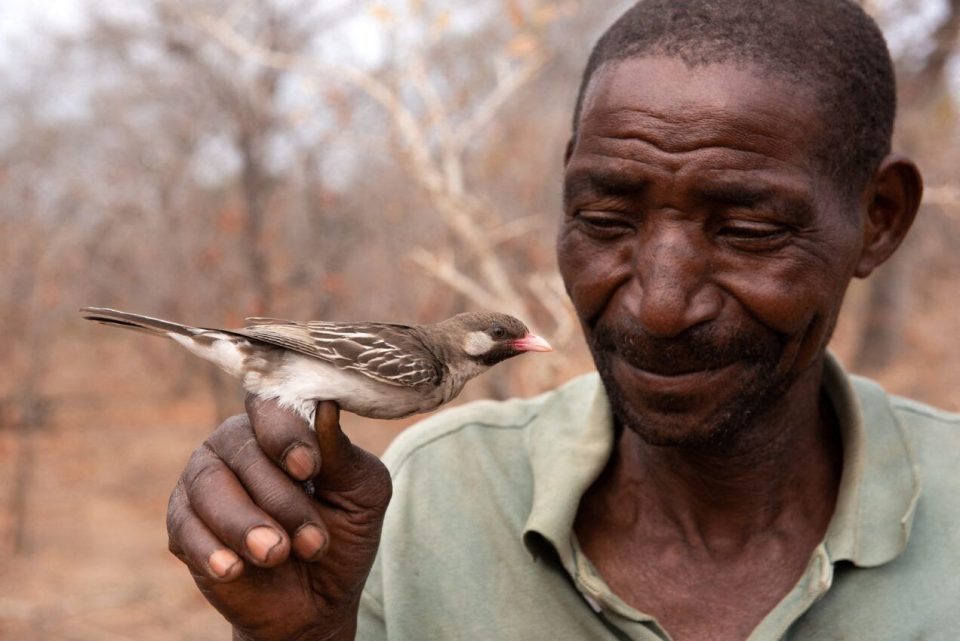
RD: Honeyguides are these sort of lovely — but not visually exciting — brownish birds that live across sub-Saharan Africa. They have a fundamental existential problem: They primarily eat wax, but they can’t get into beehives on their own. So they evolved a behavior wherein they go into human settlements, and they do a specific flight and a specific call that says, “I found a honey beehive. If you just follow me and crack it open, you can have all the honey you want. I don’t even like honey; just leave me the wax.”

Many different cultures respond to the honeyguide. I think it’s very unclear whether they independently responded to the honeyguide or it’s just such an ancient relationship that it’s part of the ancestral human story for much of Africa.
But for me, in thinking about that story, it’s also kind of a parable. It’s nature calling to humans, and humans deciding whether or not to reply. And I think nature still calls to us in all these ways, but we’re now really bad at paying enough attention to reply.
If a bird flew to you in your backyard and offered to change your life in a beneficial way, would you even be paying enough attention to notice?
SB: In terms of your own relationship with the mutualisms that you’re aware of in your own life, are there any that you are particularly intrigued by, and are there any that you really try to nurture?
RD: I spend a lot of time thinking about the relationship between humans and the microbes we use to ferment foods. The traditional cultural understanding of those relationships is so rich and so understudied that I just find it fascinating and often so rewarding. Embedded amidst the loud culture of the virtual global world are these hidden stories of deep local knowledge, of how to work with these microbes to produce delicious food that also benefits them.
In my daily life, there’s a beaver that benefits me because it dams a little creek not far from my office, and fills it with more biodiversity and more birds, and those bring me joy. I’m not cultivating the beaver, but I’m cultivating my attention towards it.
SB: A key message in your book is the need to nurture these mutualisms. You call it “a call to action for a more mutualistic, less-lonely future.” Could you unpack exactly what you’re hoping readers will take away from the book?
RD: I think the simplest call to action is to please pay attention to the rest of the living world. It is all around you. It is on your body. It is in your gut. It is covering your loved ones. It is your dog, your cat, the plants in your backyard. It is the microbes that are helping to form clouds and falling on you every time it rains.
I think the first and most important thing is to pay attention, to realize it’s there, to begin to be able to name it, to know the trees around you, to know the ants are around you. To be aware that when you smell your beer, you’re smelling the consequence of a living organism dividing in that beer and breathing into your mouth.
I think, in a time when so many feel lonely, remembering part of the remedy to that loneliness is connecting to other humans. But another part, I think — and I’ll say this as often as somebody’s listening — is connecting to other species.
We spent the vast majority of our evolutionary history in trees, in forests, in grasslands, surrounded by the rest of life. And we’re in this super-weird moment right now where that is — for so many of us — far away. And it is hard to overstate how evolutionarily unprecedented that is.
What does it look like to think about what mutualisms we want in the next hundred years? Can we be a generation that’s so creative that we begin to embark on new mutualisms?
Editor’s note: This interview has been edited and condensed for clarity.
