
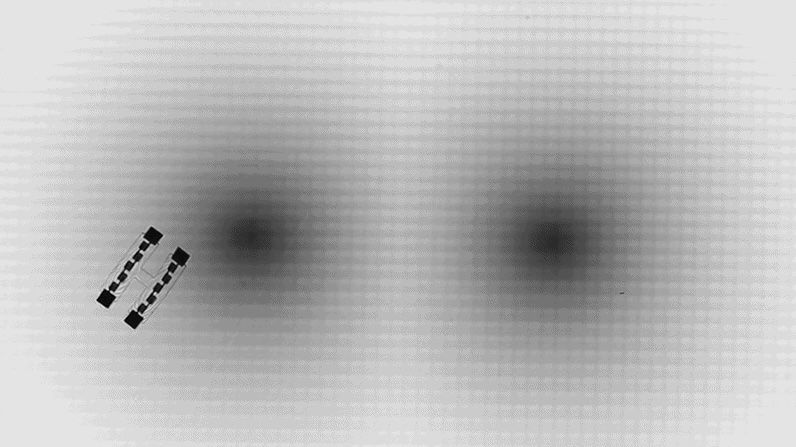
Researchers have developed a method for steering microscopic swimming robots using light patterns and the principles of Einstein’s theory of relativity. The technology is a potential first step toward deploying tiny robots in applications ranging from medicine to manufacturing.
One of the major challenges of developing microrobots for practical applications is creating ones capable of navigation without the inclusion of bulky sensors and other electronics, which would make the machines too large to operate at the desired scale (like inside a human body). In an attempt to overcome this issue, physicists at the University of Pennsylvania created “artificial space-time” to direct machines to travel in the same way that spacecraft or light does while crossing the universe.
The challenge was to guide the microscopic machines with enough precision for them to reach a specific point in space, without being stymied by the maze’s walls. That’s where relativity came in. According to Einstein’s theory of general relativity, gravity bends space-time around objects with mass. Light and objects follow “straight” geodesics — the shortest paths — that look bent around masses. A great example of this is gravitational lensing: Although light travels in a straight line across the cosmos, it can appear bent and magnified when passing through the gravitational well of a massive object, such as a large galaxy cluster.
“We showed that the way EK robots behave in patterned light fields is identical to the paths light follows in general relativity,” lead study author Marc Miskin, an assistant professor of electrical and systems engineering at the University of Pennsylvania, told Live Science in an email. “Amazingly, you can use the robots as a gravity analog since the correspondence is exact. Alternatively, you can turn general relativity ideas around to use them to guide robots: in the same way gravity pulls objects together, you can guide robots to a specific spot.”
Artificial space-time
To mimic the effect, the team modeled the maze as curved virtual space using relativity equations. Paths to the target inside the maze became simple straight lines in the model. Then, they converted the model back to a 2D light map. Dark spots naturally attracted the bots, while brighter spots repelled them. The end point of the maze was the darkest spot (a kind of faux black hole), with obstacles being more brightly lit.

Regardless of where they were initially placed, the EK bots naturally followed these geodesics, dodging walls automatically, as if sliding downhill in warped space. The team published their findings in November 2025 in the journal npj Robotics.
For Miskin, the study is a bridge between the worlds of physics and technology, “rather than a competition between them,” he said. “On the one hand, relativity and light are very well understood; connecting reactive control to them invites new ways of thinking and established tools for robotics. On the other hand, general relativity and optics are also very abstract (think bending spacetime), while robotics is mechanistic and concrete (it’s very easy to understand why the robot does what it does). In addition to showing how new types of robots behave according to known theories of optics, the experiments give researchers “a bit more” insight into general relativity, particularly in exploring the impact of “flat space-times” in 2D spaces, Miskin added.
While the maze study is a very early step, Miskin said practical applications may emerge over the next 10 years.
“Some use cases we’re interested in exploring include checking up on teeth following a root canal, a kind of dental biopsy to make sure everything was cleared, eliminating tumors after making local measurements to confirm cells are cancerous, or even, outside of bio, assembly of microchips with tiny robotic helpers,” Miskin said. “The microworld is a fascinating place; I wouldn’t be surprised if these ideas are just the tip of the iceberg.”
