
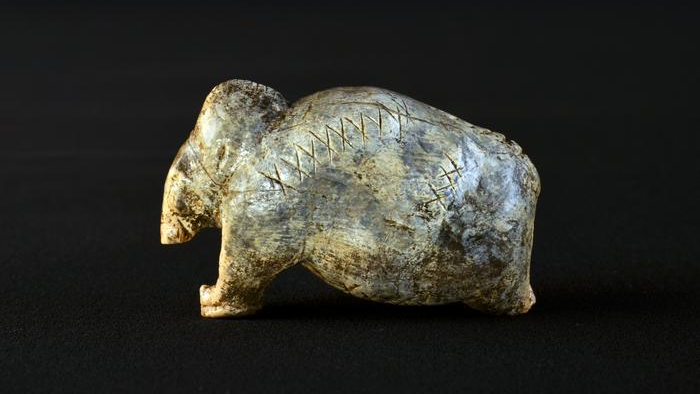
Humans first developed complex and information-dense writing around 3000 B.C., when the Sumerians of southern Mesopotamia (modern-day Iraq) invented cuneiform scripts. But new research suggests the precursors to writing can be found on sculptures and tools made by Paleolithic hunter-gatherers in Central Europe tens of thousands of years earlier.
When modern humans (Homo sapiens) first arrived in Europe around 55,000 years ago, they brought with them a sophisticated tool culture that included projectile points and drilling implements. Humans began decorating cave walls with geometric shapes, hand stencils and representations of animals, and they adorned their tools and sculptures with geometric signs whose meaning has baffled archaeologists for decades.
“Our research is helping us uncover the unique statistical properties — or statistical fingerprint — of these sign systems, which are an early predecessor to writing,” Bentz said in a statement.
The researchers cataloged intentional symbols — lines, points, crosses, stars, grids and zigzags — carved into a variety of tools and figurines, most of which were discovered in previous archaeological excavations in cave sites in the Swabian Jura, a mountain range in southern Germany. Then, they used computational techniques to look at the statistical properties of the signs, discovering that the Paleolithic sequences were comparable to proto-cuneiform in their potential to encode information.
Bentz’s research deals with frequency trends and measurable aspects of signs. (In linguistics, a sign is a physical representation of a concept or meaning.) By statistically investigating two series of signs — in this case, the Paleolithic system and proto-cuneiform — Bentz compared the sign systems to discover similarities and differences.
“Our analyses demonstrate that these sign sequences have nothing to do with the writing systems of today,” Bentz said. “The signs on the archaeological objects are frequently repeated – cross, cross, cross, line, line, line. This type of repetition is not a feature found in spoken language.”
The Paleolithic hunter-gatherers instead developed a system of symbols comparable to early proto-cuneiform, a system created tens of thousands of years later. “In terms of complexity, the sign sequences are comparable,” Bentz said.
But while cuneiform evolved rapidly in Mesopotamia over the course of a millennium, the Paleolithic sign system the researchers discovered stayed consistent for nearly 10,000 years.

“The human ability to encode information in signs and symbols was developed over many thousands of years,” Bentz said. “Writing is only one specific form in a long series of sign systems.”
The statistical analysis did not reveal what the carved signs meant, although the researchers did discover that figurines had a higher “information density” than tools did.
This is not the first research to propose that the origin of human writing systems dates to the Paleolithic. In a 2023 study, researchers investigated dots and lines in 20,000-year-old cave paintings of animals and concluded that they constituted an early calendar. And paleoanthropologist Genevieve von Petzinger has argued that three dozen symbols found in caves throughout the world show humans developed an early form of writing at least 40,000 years ago.
The new study includes “two excellent approaches for at least trying to confirm that these marks were meaningful beyond being decorative doodles,” von Petzinger, who was not involved in the study, told Scientific American. “The more we can learn about the selection of ‘writing’ surfaces and choices about specific images and signs, the more we will be able to learn about this period.”
The researchers continue to look for objects with intentionally made signs to add to their understanding of early human communication.
“Countless tools and sculptures from the Paleolithic, or the Old Stone Age, bear intentional sign sequences,” Dutkiewicz said in the statement. “There are many sign sequences to be found on artefacts. We’ve only just scratched the surface.”
Bentz, C., & Dutkiewicz, E. (2026). Humans 40,000 y ago developed a system of conventional signs. Proceedings of the National Academy of Sciences, 123(9), e2520385123. https://doi.org/10.1073/pnas.2520385123
