
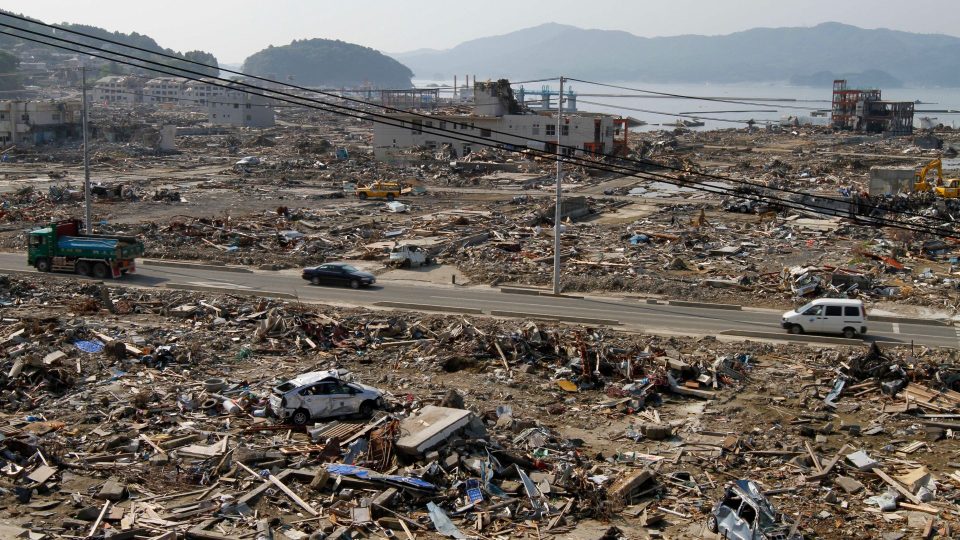
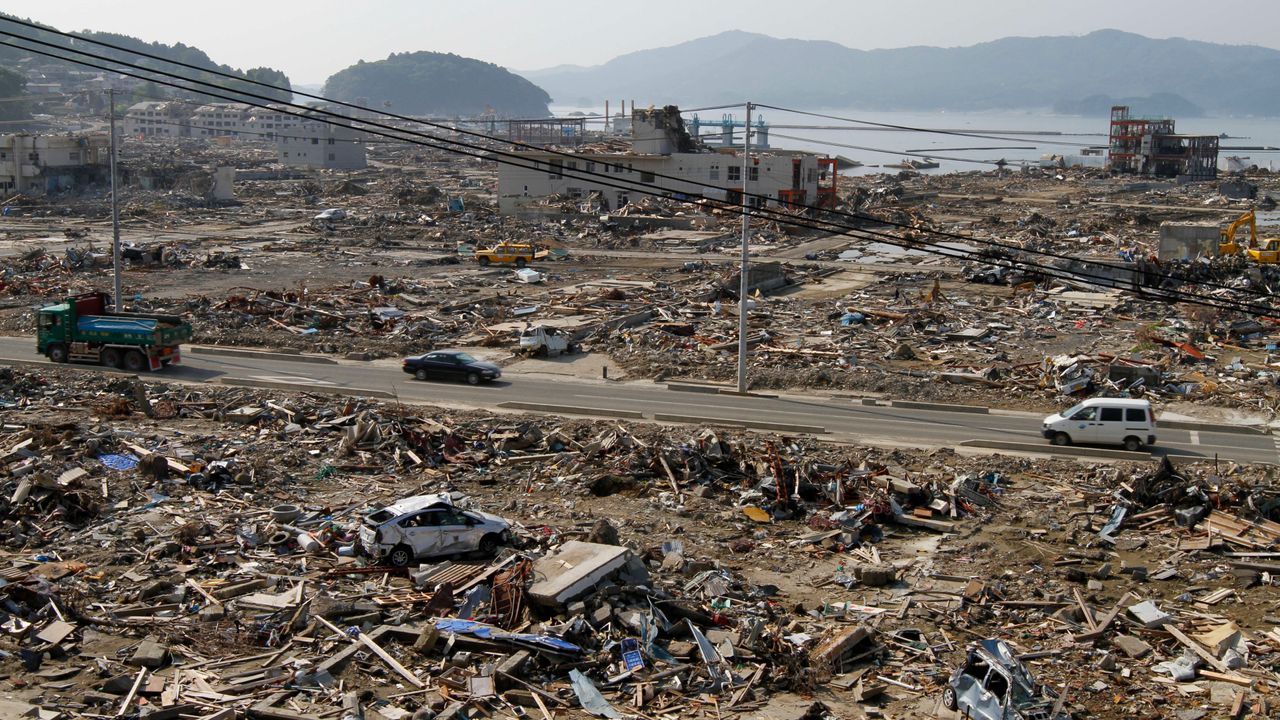
The 2011 Tohoku earthquake that triggered a devastating tsunami in eastern Japan was worsened by a thick layer of slippery clay, new research finds.
The clay layer, which was up to 98 feet (30 meters) thick on the ocean floor, created a weak spot that enabled the magnitude 9.1 quake’s movement to travel all the way to the seafloor. That motion thrust the seafloor upward by 164 to 230 feet (50 to 70 m) over about 310 miles (500 kilometers). And the motion of the seafloor thrusting into the overlying ocean is what created the tsunami wave that inundated 217 square miles (561 square kilometers) of Japan.
The side-to-side breakage of the fault was about half of what researchers would have expected, Hackney told Live Science, which concentrated the upward motion into a smaller area, probably intensifying the resulting tsunami. The findings explain why the tsunami was larger and more concentrated than expected, he said, and these kinds of detailed studies can help provide better warnings for future quakes.
“We can be a bit more prepared in terms of informing people of what to expect and how to respond when an earthquake does happen,” he said.
The 2011 quake happened along a subduction zone, where the Pacific Plate slides under Japan. In 2024, Hackney and other researchers aboard the research vessel Chikyu drilled directly into the fault that caused the quake. After drilling 23,000 feet (7,000 m) below the ocean surface and another 3,300 feet (1,000 m) below the seafloor, they pulled up cores of sediments from within the fault and from the Pacific Plate.
They found that the Pacific Plate is covered with a thick, goopy layer of clay that has been accumulating slowly for around 130 million years. This layer compresses as the Pacific Plate pushes under Japan, also squeezing the continental rocks above. The result is a mechanical weak point, almost like a perforation on a piece of notebook paper, where the rock is prone to breaking.
The researchers published their findings December 2025 in the journal Science.
Similar clay layers may or may not exist at other subduction zones, Hackney said. There is some evidence that they might be present near Sumatra, Indonesia, the site of the magnitude 9.1 earthquake that caused a devastating tsunami on Dec. 26, 2004. But less is known about the materials coming into the fault zone at places like the Kamchatka Peninsula, where large quakes also occur, he said.
Hackney and his colleagues are working to find links between topography and rock density and ultimate earthquake movement. Earth scientists are getting increasingly good at predicting how large a quake will be and where the shaking will be felt once a quake happens, enabling early warning systems that can alert people to incoming shaking seconds to minutes in advance. Tsunami warnings have an even longer lead time, so perfecting the understanding of how the seafloor moves to better predict where a tsunami will go could save even more lives.
Kirkpatrick, J. D., Savage, H. M., Regalla, C., Shreedharan, S., Ross, C., Okuda, H., Nicholson, U., Ujiie, K., Hackney, R., Conin, M., Pei, P., Satolli, S., Zhang, J., Fulton, P., Ikari, M., Kodaira, S., Maeda, L., Okutsu, N., Toczko, S., & Eguchi, N. (2026). Extreme plate boundary localization promotes shallow earthquake slip at the Japan Trench. Science, 391(6784), 489–493. https://doi.org/10.1126/science.ady0234
